
Forsyth County Public Records Map
Forsyth County public records begin with the keeper, not with one countywide database. The Register of Deeds holds recorded instruments and local vital indexes. The Clerk of Superior Court keeps case, estate, will, divorce, and special-proceeding files. Tax Administration maintains parcel and billing data. State agencies operate court, correction, registry, license, and business systems. The table leads with what exists, where it sits, and what a remote search can actually reach.
| Record group | Official keeper | Web coverage | How access works |
|---|---|---|---|
| Deeds, liens, plats, mortgages | Register of Deeds | Free index; scattered early instruments; computer indexing began in 1965 | Free real-estate images; plain and certified copies by office or mail |
| Court cases, estates, wills | Clerk of Superior Court | eCourts party and case search since July 21, 2025 | Public docket online; terminal, paper file, and certified-copy fallback |
| Parcels, tax bills, sales | Tax Administration | Property details; current and prior paid-bill year; sales since 2021 | Free portals or office help |
| Birth, death, marriage, divorce | Register of Deeds, Clerk, or NC Vital Records | Local vital index only; no certificate images | Certified eligibility and ID rules; unofficial local copies available |
| Police, correction, registry | WSPD, Sheriff, DAC, or SBI | System-specific tools; no verified county jail roster | Public facts only; investigations and protected details excluded |
| Business and professional licenses | Secretary of State and issuing boards | Entity search and board-specific verification | Free interactive lookup; certified filings from the keeper |
Open does not mean every field is visible. Sealed and expunged cases, juvenile files, involuntary commitments, adoption material, active criminal investigations, protected voter addresses, alarm-registration data, and selected vital fields remain limited. A specific confidentiality law controls over Chapter 132. An online gap also does not prove that the underlying record is gone.
North Carolina Records Access Rules
North Carolina Public Records Law, Chapter 132, broadly covers documents, maps, photographs, recordings, and electronic data made or received in public business. Any person may inspect covered material at reasonable times under reasonable supervision. Copies must be supplied “as promptly as possible.” The law sets no universal number of days, so a fixed deadline should not be assumed.
Uncertified copies ordinarily cost no more than actual reproduction cost. An agency may add a reasonable special service charge when a request needs extensive technology or staff work, but the charge must reflect the labor or resources used. Agencies may meet access duties by posting downloadable records. If part of a record is withheld, ask for the cited legal basis and any segregable portion that can be released.
The Judicial Branch administrative-record request form is often misunderstood. It is meant for administrative material, not Forsyth County case files. The captured form below preserves that distinction. Parties, docket entries, estates, and judgments belong with the local clerk.
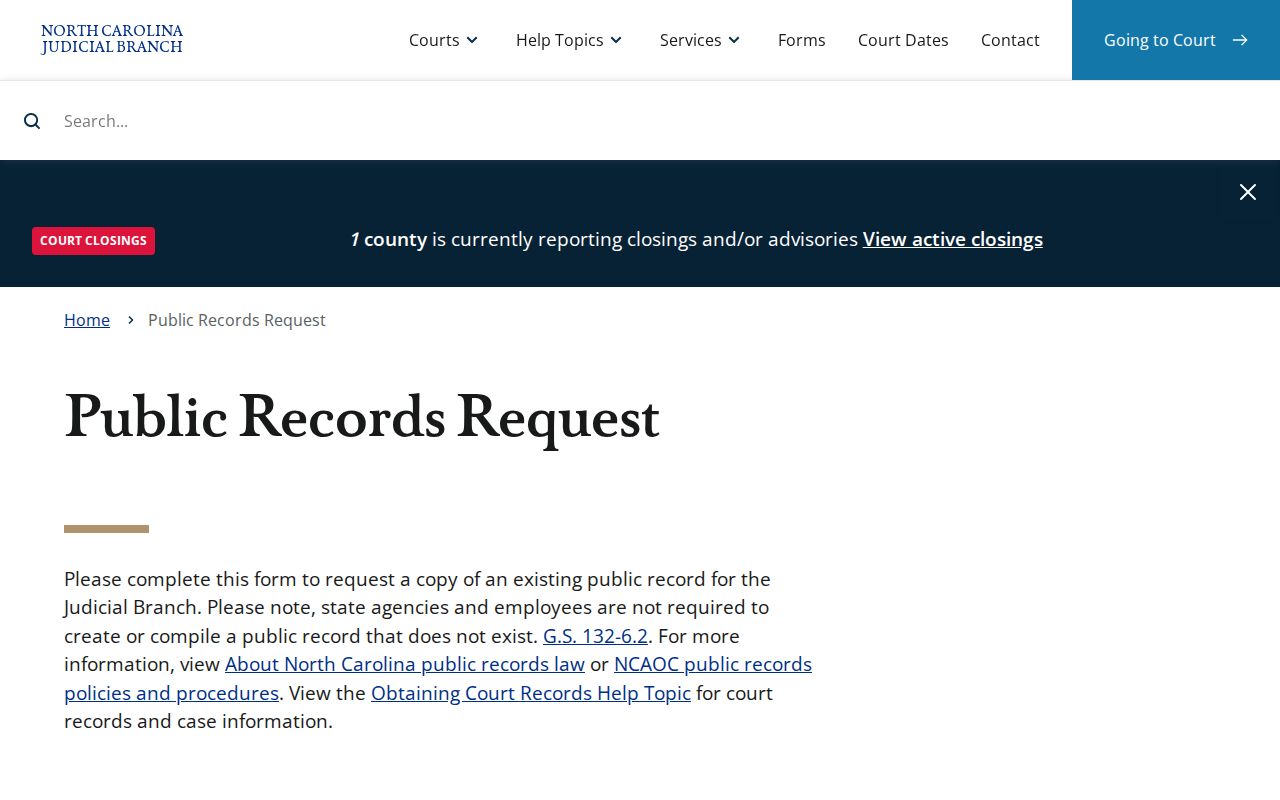
A well-routed request avoids delay and keeps the request narrow enough for the proper office to identify an existing record.
Note: Chapter 132 opens existing government material, but it does not require an office to build a new report or custom database.
Forsyth County Deed Record Layers
The free Forsyth Online Record Search covers land, miscellaneous documents, and vital indexes. Real-estate instrument images can be viewed without charge. Birth, death, and marriage certificate images never appear there. Recorded groups include deeds, mortgages, foreclosure notices, satisfactions, assumed business names, rights-of-way, plats, leases, covenants, UCCs, affidavits, powers of attorney, and living wills. Estates, wills, and divorces go to the clerk instead.
Public records coverage needs care. Some instruments reach county formation in 1849, but the office says official Forsyth recording began in 1913. Early records were copied by hand, then typed and microfilmed. Computer indexing started in 1965. These facts do not show that every early instrument has complete online name metadata. When the index misses an expected record, ask the office for the applicable book, manual index, microfilm, or copy service.
- Index
- A finding aid with names, dates, document type, and recording reference. It is not always the full instrument.
- Image
- A scan of the recorded page. Real-estate images are available online, while vital certificate images are not.
- Certified copy
- A copy authenticated by the custodian for an official purpose.
- Custodian
- The office responsible for keeping and releasing a particular record.
- Exemption
- A law that withholds a record or field even when related material is open.
Note: A free index result can identify an instrument, but only the image or office copy shows the complete recorded text.
Search Forsyth County Court Records
Forsyth County joined statewide eCourts on July 21, 2025. Anonymous users can search the Portal without registering. A default Smart Search accepts a case number or party name. Advanced controls narrow by location, party, birth date, case type, status, and filing dates. Public results may show assignments, party roles, causes of action, events, dispositions, hearings, financial entries, and judgments.
| Portal field | Input | Rule or use | Format note |
|---|---|---|---|
| Case Number or Party Name | Text | One value for default Smart Search | Case wildcard needs four characters plus * |
| Location | Filter | Optional county or court narrowing | Select Forsyth when needed |
| Party Name | Text | Optional advanced field | Last name needs three characters plus *; first name one plus * |
| Case Type and Status | Dropdowns | Optional | Civil, public special proceedings, estates, or criminal |
| Filing Date | Date range | Optional | Start and end dates |
The official Portal training resources explain wildcard and search modes. If a document is absent, use a courthouse terminal or ask the clerk for the paper file. Terminals can search criminal, civil, estate, and special-proceeding material. Nonconfidential audio may be requested on AOC-G-114 at actual CD cost. Juvenile or involuntary-hospitalization audio requires court permission through AOC-G-115.
Confidential, sealed, juvenile, and entitlement-restricted files do not become open merely because the platform changed.
Note: A missing Portal document can still exist in the Forsyth County clerk’s paper file or on a public courthouse terminal.
Forsyth County Vital Record Copies
The Register of Deeds issues local birth, death, and marriage copies. NC Vital Records handles statewide events and adopted birth records, while the clerk keeps divorce judgments. North Carolina uses eligibility and record-field rules, not a simple rule that all certificates open after a set number of years. Certified local copies require photo ID and a qualifying relationship or legal interest. An unofficial local copy has no seal and needs no ID.
The Forsyth vital-record ordering page documents counter, mail, and online channels. Its captured application information appears below. Walk-in orders are normally same day. Mail generally takes two to three business days and needs a separate application, exact payment, ID copy when required, and a stamped return envelope. The online Permitium route applies only to Forsyth-filed events and may take up to 45 days.
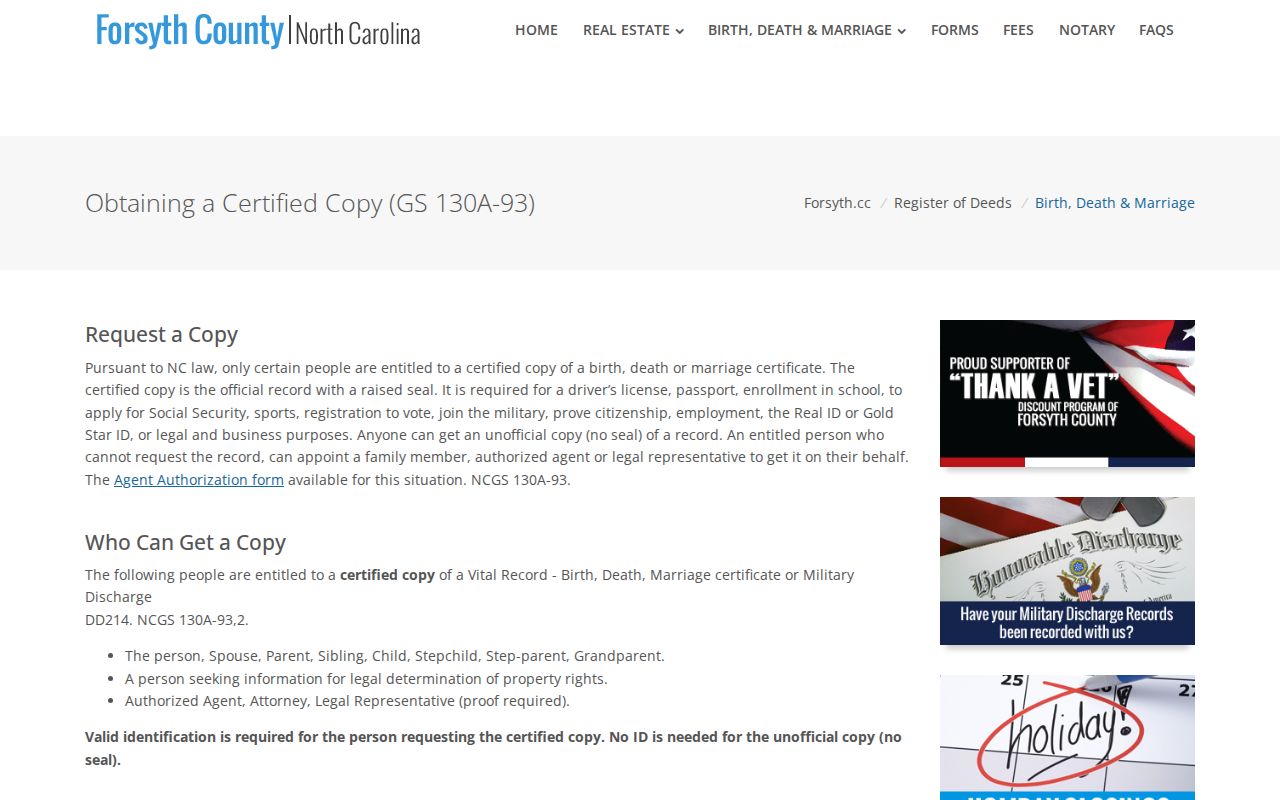
The office advises waiting ten days after a recent event so the record can arrive and be processed. No fax, email, or telephone copy order is offered.
Forsyth County Property Record Trail
Three systems divide the work. The Forsyth Tax Property Portal supplies detailed property information, printable cards, tax tools, and parcel access. MapForsyth provides boundaries and map layers. The deed index supplies the legal instruments behind ownership. Tax Bill Online Services includes current and one prior billing year for paid online bills. Forsyth Sales covers residential and commercial transactions since January 1, 2021, with weekly updates.
A parcel card or map is not a deed. Tax and GIS data help identify the parcel, its current administrative record, and the right jurisdiction. The recorded deed then establishes the parties, legal description, and transaction. Plats tie a subdivision, lot, and boundary to the land trail. For a disputed description or title issue, rely on the source instrument and suitable professional advice rather than a tax map disclaimer.
Note: City code and permit entries may name an owner or applicant from a past date, but they do not prove present ownership.
Forsyth County Records Offices
Several main custodians sit near North Chestnut Street in Winston-Salem, yet their duties do not overlap. The Register of Deeds records land and vital indexes. Tax Administration handles appraisal, mapping, bills, and sales. The Clerk of Superior Court keeps local case files, estates, wills, divorces, and certified court copies. Weekday counter service remains essential for paper holdings and records not exposed by a web portal.
Register of Deeds
201 N. Chestnut Street, second floor
Winston-Salem, NC 27101
Monday through Friday, 8 a.m. to 5 p.m.
336-703-2700
Tax Administration
201 N. Chestnut Street
Winston-Salem, NC
Monday through Friday, 8 a.m. to 5 p.m.
336-703-2300
Property, mapping, bills, and sales
Clerk of Superior Court
175 N. Chestnut Street
Winston-Salem, NC
Mail payments: PO Box 20099, Winston-Salem, NC 27120-0099
Call the responsible desk before a long visit if the desired item is old, restricted, or held only on paper. A courthouse order effective November 10, 2025 limits many phones, computers, tablets, cameras, smart devices, and recording tools. Ask the clerk what note-taking and copy options are currently permitted.
Forsyth County Custody Records
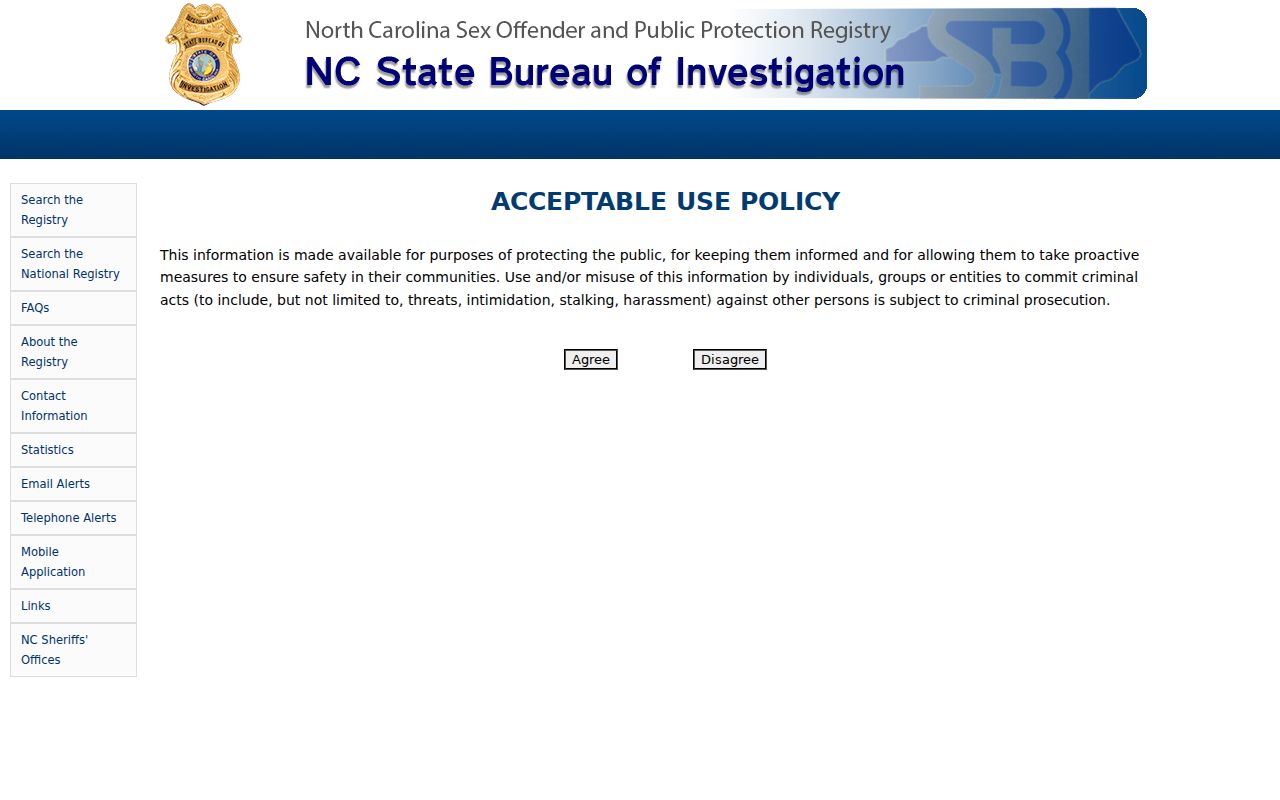
Jail, correction, registry, and police sources describe different legal states. No verified official live Forsyth County jail roster was found, so the Sheriff is the proper source for local custody questions. The state correction system supplies statewide custody data. The SBI registry covers a statutory registration duty, not current incarceration. A charge or arrest is not a court disposition; confirm the result through eCourts and the clerk file.
The official North Carolina registry is shown in the captured screen below. Read its result dates and legal notice, and use the information only for lawful safety purposes.
Winston-Salem Police Records provides forms, Police-to-Citizen access, a Cherry Street counter, and a separate crash search. Its weekday counter is open from 8 a.m. to 5 p.m.; requests can also begin through 336-773-7922 or recordsdivision@wspd.org. The division maintains incident, arrest, warrant, wanted or missing person, stolen vehicle, property, and gun data. Active investigation and intelligence records are exempt, though specified incident and arrest facts remain open.
Forsyth County License Record Sources
North Carolina license research is board-specific. The state’s central license-agency list points to the office that issues a credential, but it is not one consolidated person database. Each board’s verification system controls what status and discipline details appear. Business entities and statewide assumed names filed on or after December 1, 2017 are searched through the state business registry, while county registers remain the official keepers of local assumed-name certificates and older filings.
The North Carolina Medical Board verification search is one example of a primary-source license tool. Its captured form illustrates why the issuing board should be consulted directly.
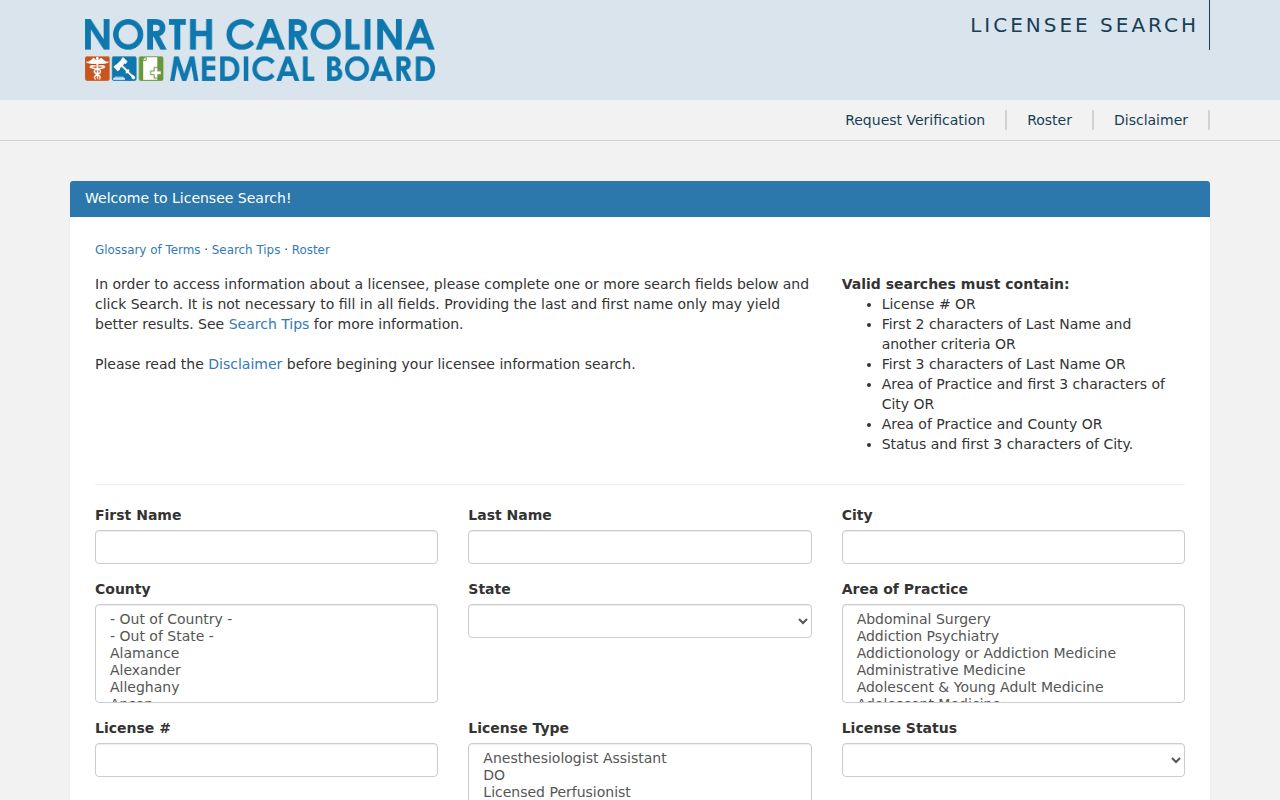
A license result should be read for the credential type, current status, dates, and any board-provided action record. Do not treat an entity filing, trade name, and individual professional credential as interchangeable records.
Forsyth County Record Copy Costs
Viewing an index may be free even when an authenticated copy costs money. The Register of Deeds charges 25 cents per page for a plain real-estate copy. Certification costs $5 for the first page plus $2 for each added page. Local vital copies cost $10 certified or 50 cents unofficial at the counter. A certified single-county criminal search through the clerk costs $25, while a free terminal search is noncertified.
| Copy or service | Published charge | Access detail |
|---|---|---|
| Real-estate image online | Free | View through the deed system |
| Plain real-estate copy | $0.25 per page | Register of Deeds |
| Certified real-estate copy | $5 first page; $2 each added page | Authenticated by the office |
| Local vital copy | $10 certified; $0.50 unofficial | Walk-in, mail, or eligible online route |
| Online local vital order | $15.11 per copy | Forsyth-filed events only |
| Certified county criminal search | $25 | AOC-CR-314 through the clerk |
Mail payment methods vary by office. Vital mail accepts a business check, bank check, or money order and requires exact payment. Ordinary Chapter 132 requests follow actual-cost rules, while certified copies and specialized records follow their own statutory schedules. Confirm the amount and accepted method before sending funds.
Forsyth County Records Through Time
Forsyth County’s authentic preservation story is a shift in media, not a courthouse-loss tale. The county was formed in 1849, yet the Register of Deeds describes official Forsyth recording as beginning in 1913. Each later system made some searching easier without ensuring that all older pages gained full party metadata. The current index must therefore be paired with books, film, and staff help when early names disappear.
- 1849 to 1904: early records were copied by hand.
- 1904 to 1929: typed documents became the main form.
- 1954: the office introduced microfilming.
- 1962: birth, death, and marriage records were integrated into the system.
- 1965: computerized indexing began.
- 2025: Forsyth entered eCourts while old plats, deed books, and microfilm continued through imaging work.
Hand copying can carry clerk spelling or transcription differences. Film preserves page order but may still require a manual index. Digital access speeds retrieval, yet a preservation goal is not proof that every volume is searchable. The source image remains worth reading against the index entry.
Note: Search both Winston and Salem for records created before the cities merged in 1913, then add Winston-Salem for later material.
Forsyth County Record Fraud Alerts
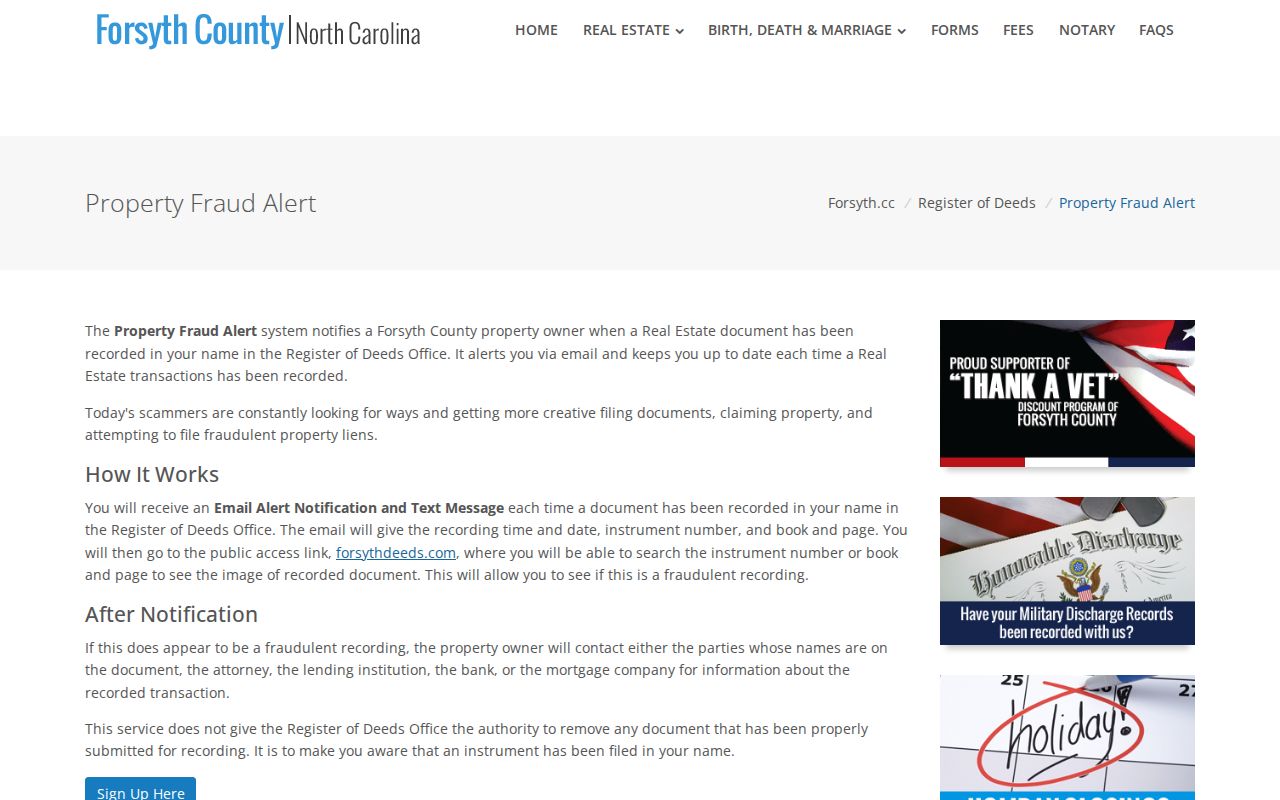
Forsyth County’s free Property Fraud Alert sends email or text when a recorded document is indexed under a subscribed name. A notice includes recording date and time, instrument number, and book and page. That lets the subscriber open the deed image and assess the filing. The service detects activity. It does not block a recording, prove fraud, correct title, or let the Register of Deeds remove a properly submitted instrument.
The official Property Fraud Alert instructions and enrollment path appear in this capture.
If an alert is unexpected, inspect the image and contact the parties, lender, attorney, or other proper source. A written, no-fee request under N.C.G.S. §132-1.10 can redact specified exposed identification or financial numbers from an online image. It does not erase the recorded transaction or ordinary party names.
Request Forsyth County Public Records
A useful public records request names the existing item and reaches its true custodian. Start with the official index because it may supply the case, parcel, instrument, or report number needed by staff. Then ask for inspection, an electronic file, a plain paper copy, or a certified copy. Chapter 132 does not require an office to create a new compilation that it does not already keep.
- Name the record and keeper. Send deeds to the Register of Deeds, cases to the clerk, property data to Tax Administration, and agency records to the department that made or received them.
- Check the official portal. Note names and variants, a date range, record type, and any case, parcel, report, book, page, or instrument number.
- Describe an existing item. State the fields, date span, format, and whether inspection or a copy is wanted. For police material, request released incident or arrest facts rather than an entire investigation.
- Choose the copy level. Ask whether a free electronic file, plain copy, or certified copy meets the need. Confirm fees and payment method first.
- Address a partial denial. Ask for the law supporting each withheld part and request any separable public portion. Chapter 132 enforcement proceeds under N.C.G.S. §132-9.
No fixed response-day rule applies. “As promptly as possible” is the statutory standard. For old records absent online, the fallback chain is the keeper’s counter, manual index or paper file, local library collections, state archive holdings, and then a focused request to the custodian.
Lawful personal use. Open records support family history, estate work, civic review, and fraud checks. Never use them to stalk, harass, threaten, evade a protected-address program, or harm another person.